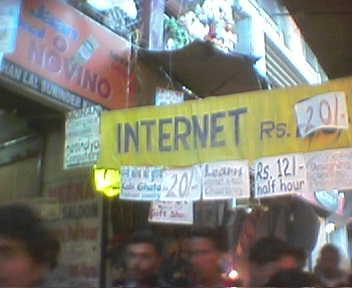
tech Start-ups from the proverbial garage , so obviously expect media publsihers from a cyber Cafe !
Tobi Elkin, in mediapost narrates about how the online journalism group ContentNextMedia Inc's founder Mr. Rafat Ali began his venture. Mr Ali publishes reports on various business niches like Digital Media ( PaidContent.org) , Indian Digital media ( contentsutra.org ) on a blog. These niche publication have created a market for themselves and now attracting lot of interest form venture capitalist.
Elkin mentions :
“Ali's been boot-strapping his business via advertising revenue and sponsor dollars for a while now. Not bad for a guy who started the site from a cold-water flat in London after being exiled from New York due to visa issues. All the more impressive since the flat didn't have Internet access; Ali produced his blog at cybercafes and coffee shops; he uploaded the content from computer disks.”
We talk of proliferation of Internet access at home & at office but few understand any reason to have shared public access to Internet.
Monday, July 10, 2006


Thursday, July 06, 2006
India: Survey claims half of internet users access it from cyber cafes
A survey on Internet usage pattern conducted by Times News Network comes out with interesting analysis.
Almost half, 46%, of internet users access it from cyber cafes !
The net penetration of just around 10% of urban Indian population hooked onto the Net, and almost half of all computer using Indians (around 50 million ) on the Net, internet has already reached at an inflexion point as far as becoming a viable mass-media.
Shared Internet Access Platform can offer a multiplier effect in reaching higher internet penetration.
heres the way to go ...
read more
Thursday, June 29, 2006
Internet cafes Candidate for Google webOS ?
Venkatesh Rangarajan writes: (via Emergic) notes WebOS can work well in Internet Cafes ! .
Taking note of the SIFY Iway A franchised cyber cafes chain ( India ), esti market share less than 3% :
Cyber cafes hardly need harddisk space . The excess space is a menace. Good synery but I think we will have to wait until broadband is firmly- consistent & dependable conectivity is established in conutries like India
About 60% of Indian users access their broadband internet in cyber cafés and SIFY has most of this market share. Lot of Indians have their first broad band experience in one of these cyber cafes which are very popular with the school and college kids.
Taking note of the SIFY Iway A franchised cyber cafes chain ( India ), esti market share less than 3% :
They have computers which are stripped down Microsoft Windows with absolutely minimal storage options. Once the user logs out of the computer all the files created during the session are deleted, so the only option is saving the files as an attachment in an email message. Besides local storage doesn’t make sense, since it’s a shared PC and users might end up using a different PC during the next visit to the cyber café.
These computers have the mandatory Microsoft Office which is used mainly for editing or updating resumes. These machines are strictly meant for browsing, but lack of choice in terms of operating system limits them to using Microsoft Windows.
Companies like Google, Yahoo which are putting together the components for a WebOS, should take a closer look at iWays, since webOS has better chance of getting accepted in this model. If Google were to launch a Gdrive, online storage of bookmarks, Word Processor, Spread Sheet etc which could be delivered over the web
Cyber cafes hardly need harddisk space . The excess space is a menace. Good synery but I think we will have to wait until broadband is firmly- consistent & dependable conectivity is established in conutries like India
Monday, June 26, 2006
BT opens insanely fast 100Mbps internet cafe
Adam Vaughan in Stuffmag.co.uk reports on Cornwall’s Goonhilly communications centre opens its doors to a 100Mbps internet café.
The speed will be more than 4 times what you experience at home. In mature markets like in Europe, Interent Cafes where almost everyone has a PC at home. The internet cafe need a distinct advantage to attract customers in .
ISPs have been slow in colloborating with private Interent Cafes. This will hopefully will create a new market for I-cafes.
Saturday, June 24, 2006
Spain: Cybercafes: after the boom comes diversity
Antonio Campos in SUR, a newspaper in Southern Spain reports with more and more people are connected at home, the profile of custoemrs visiting cyber cafe in Malaga city has changed dramatically. A cafe operator tells regulars are “young people, immigrants and tourists”. This description would have been different at the end of the 90s when Internet became popular but still had not reached the homes of as many as it does today.
Internet access at home has affected the Internet Cafe business in Europe and all developed cities.
Internet access at home has affected the Internet Cafe business in Europe and all developed cities.
Australians to get free porn filters
ZDNet Australia reports , Australian goverments proactive stance over Internet filtering. They plan to spend about $86 million (£47m) to provide all the country's families with free Internet pornography-blocking software.
"It puts a safer Internet experience within the grasp of every Australian family, and it is a solution to the problem posed by Internet pornography that is simple, safe, effective and free," Coonan said in a statement.
Helen Coonan, the minister for Communications, Information Technology and the Arts, announced "Every parent will be able to receive a free filter for their home computer, (and) there will be child-safe terminals in libraries across Australia.Futher all ISPs will also be required to offer filters to new and existing customers at no additional cost."
I feel Autralian goverments initiative will be worth immulating for other countries who are grapping Internet pornography issues with mindless regulations like in Philipines or in India & many other countries.
Cyber Cafes fast replacing Game Arcades
Brian D. Crecente editor of kotaku.com, a gamers guide notes Cyber Cafes are fast replacing the game arcades. The Pin balls are hardly visible. Some of the reasons Brian cites is due to advent of high-end consoles, a rapid varieties of computer games, arcade games have been slow in upgrading. Further computer games have been more interactive, Some comments to his post also observe arcade games have been dumbbing down and offer no more value for money.
Microsoft helps Iraqi Women set community centres
Microsoft Corp is working to support the economic empowerment of women in Iraq through its initiative to support women in technology.
On June 11 at the Global Summit of Women, Microsoft Corp, in conjunction with the Middle East Partnership Initiative (MEPI), launched an initiative to support women in technology (WIT) in the Arab region. The Institute of International Education West Coast Center will manage and implement the project in collaboration with local partners.
The WIT program aims to afford women in Iraq the opportunity to enhance their marketable skills and gain economic independence.
The program will help build community centers that will work to provide women with both IT skills and general business skills and create a network of female organizations in Iraq.
Philipines: Lapu-Lapu City regulates Internet cafe operations
A police raid on an apartment rented that was allegedly a venue for producing pornographic Internet content. was enough reason for the Lapu-Lapu City Council yesterday approved an ordinance regulating the operation of Internet cafes !
naturally the city Internet cafes are upset with the new law which has numerous loop holes.
Read the complete story at http://globalnation.inq7.net/cebudailynews/metro/view_article.php?article_id=6010
Courtesy : inq7.net
The ordinance, which “regulates the operation, design, layout and construction of all Internet cafes and other establishments engaged in similar business within the city of Lapu-Lapu,” does not ban cubicles or other enclosures, but stipulates that such enclosures should allow a user to be visible from the outside.
The ordinance also regulates the entry of students into Internet cafes during school hours.naturally the city Internet cafes are upset with the new law which has numerous loop holes.
Read the complete story at http://globalnation.inq7.net/cebudailynews/metro/view_article.php?article_id=6010
Courtesy : inq7.net
Monday, June 19, 2006
India: Railway Stations to have Cyber Cafes
India: Railway stations to have cyber cafes
Special Correspondent, The Hindu
VSNL awarded franchisee rights for cyber cafes in 68 stations
Bangalore: Telecommunications major VSNL is now enabling customers to stay connected on the move by setting up cyber cafes at major railway stations across the country to create user-friendly public Internet access points. VSNL has been awarded franchisee rights for running cyber cafes at 68 locations in pursuance of the agenda outlined by Railway Minister Lalu Prasad in his Railway Budget for 2006-07.
The first such cyber cafe has been opened at Bangalore City Railway Station.
Speaking about the service, Shashi Kalathil, president, Broadband and Retail Business of VSNL, said, "This effort will enable VSNL fulfil the promise made in the Union Railway Budget of setting up such cyber cafes in leading railway stations in the country. We are keen on making the Internet easily available so that passengers can stay connected while on the move."
VSNL plans to make all the 68 cyber cafes operational in the next few weeks. All Tata Indicom dial-up Internet and broadband subscribers can use this facility on their existing accounts. Each of these cafes will be equipped with 10 to 20 multimedia PCs (personal computers) and will be open 24 hours. Travellers can avail themselves of Internet browsing and gaming facilities at affordable rates. VSNL also plans to offer other value-added services such as printing, scanning, mobile charging and CD-writing through these cafes.
Passengers can also use the cyber cafes for making onward bookings, checking their bank statements, tracking their investment portfolio and making ISD calls.
Tata Indicom will also create select areas in the railway station that are wi-fi enabled, allowing passengers wireless access to the Internet on their laptops or PDAs.
Sunday, June 04, 2006
India: Microsoft & CAP train Cafe operators on online Safety
India: Microsoft Teams with CAP to Train cyber cafe owners to ensure online safety of children and safe Internet usage.
Microsoft Teams with CAP to Train Victims of Human Trafficking in ITIT News Online Staff2006-05-31Microsoft Corp. India Private Limited, under its Project Jyoti program, has announced a grant of around Rs. 2.2 crore to CAP (Child and Police project), a Hyderabad-based NGO, to provide IT skills training to victims of human trafficking as well as vulnerable communities at risk of trafficking.CAP, along with Delhi-based Prayas and other NGO partners, will engage with these communities to set up a network of 95 Community Technology Learning Centers (CTLCs) across key urban and semi-urban centers in India. The CTLCs will also be located in strategic locations in Nepal, Sri Lanka, Bangladesh and Vietnam.Through this program Microsoft aims to extend the benefits of IT to 38,590 people over the next three years. Additionally with support from the QUEST Alliance, CAP's life skills training curriculum will be digitized to ensure wider distribution. Under the project, training will also be provided to cyber cafe owners to ensure online safety of children and safe Internet usage.Neelam Dhawan, Managing Director, Microsoft Corp. India Private Limited, said, "At Microsoft we are committed to extend the benefits of technology to the grass root level and thereby help build a digitally inclusive India. Our special focus is on the underserved vast majority which risks being on the fringes in terms of IT access. In this context, we are very happy to engage with CAP for enabling IT empowerment of victims of human trafficking. We are confident this skills enhancement will be vital in equipping these individuals to explore sustainable livelihood options."Nalini Gangadharan, Chairperson, CAP, said, "At CAP we strongly believe that economic development and providing the right avenues for employment can help in reducing the risk of human trafficking. The government and voluntary organizations alone cannot provide such opportunities to the underserved sections of the community. It is excellent that companies like Microsoft are coming forward to provide such avenues for growth and development. We look forward to our association with Microsoft in reducing the growth of trafficking in India and the adjoining regions."Rajib Haldar, Executive Director, Prayas, said, "Prayas has been working with the government and various other bodies for a long time to counter the threat of human trafficking. With companies like Microsoft joining the battle, it would provide greater strength and a critical support base to the cause. Microsoft's association in providing IT skills training to the victims and communities vulnerable to trafficking will help us address the problem at its root, by giving livelihood opportunities to the community with high rates of poverty and unemployment."Aakash Sethi, Executive Director, QUEST Alliance, said, "The QUEST Alliance evolved out of a growing convergence of interests among private and public organizations to effectively deal with the problems of quality and relevance in the Indian education system. We are pleased that industry leaders like Microsoft have come forward and taken the lead in bridging the digital divide by providing IT skills training to disadvantaged youth and demonstrate the meaningful role the private sector can play in creating partnerships with civil society organizations."Microsoft said human trafficking has become a matter of grave concern. Poverty and unemployment with almost no access to any opportunities for skills development results in youth, especially women, becoming easy targets for trafficking. With IT becoming an inherent part of any employment opportunity, skills in IT combined with life skills and work readiness programs can be very effective in creating employment opportunities in areas and communities which are most susceptible to trafficking as well as for enabling re-integration of victims of trafficking.The CAP project will begin to roll out in India in June 2006. It is part of a larger regional initiative wherein Microsoft is giving out grants to NGOs to combat human trafficking across six countries in Asia, namely Indonesia, Cambodia, Philippines, Thailand and Singapore, besides India. This regional initiative focuses on the strengths of several Microsoft programs on the complex issue of exploitation and abuse. Designed to enhance local and international efforts to end trafficking in persons, the initiative works in conjunction with governmental, NGO and other corporate partners and includes support for awareness, prevention, enforcement and re-integration programs.http://www.itnewsonline.com/showstory.php?storyid=4119&scatid=8&contid=1
Microsoft Teams with CAP to Train Victims of Human Trafficking in ITIT News Online Staff2006-05-31Microsoft Corp. India Private Limited, under its Project Jyoti program, has announced a grant of around Rs. 2.2 crore to CAP (Child and Police project), a Hyderabad-based NGO, to provide IT skills training to victims of human trafficking as well as vulnerable communities at risk of trafficking.CAP, along with Delhi-based Prayas and other NGO partners, will engage with these communities to set up a network of 95 Community Technology Learning Centers (CTLCs) across key urban and semi-urban centers in India. The CTLCs will also be located in strategic locations in Nepal, Sri Lanka, Bangladesh and Vietnam.Through this program Microsoft aims to extend the benefits of IT to 38,590 people over the next three years. Additionally with support from the QUEST Alliance, CAP's life skills training curriculum will be digitized to ensure wider distribution. Under the project, training will also be provided to cyber cafe owners to ensure online safety of children and safe Internet usage.Neelam Dhawan, Managing Director, Microsoft Corp. India Private Limited, said, "At Microsoft we are committed to extend the benefits of technology to the grass root level and thereby help build a digitally inclusive India. Our special focus is on the underserved vast majority which risks being on the fringes in terms of IT access. In this context, we are very happy to engage with CAP for enabling IT empowerment of victims of human trafficking. We are confident this skills enhancement will be vital in equipping these individuals to explore sustainable livelihood options."Nalini Gangadharan, Chairperson, CAP, said, "At CAP we strongly believe that economic development and providing the right avenues for employment can help in reducing the risk of human trafficking. The government and voluntary organizations alone cannot provide such opportunities to the underserved sections of the community. It is excellent that companies like Microsoft are coming forward to provide such avenues for growth and development. We look forward to our association with Microsoft in reducing the growth of trafficking in India and the adjoining regions."Rajib Haldar, Executive Director, Prayas, said, "Prayas has been working with the government and various other bodies for a long time to counter the threat of human trafficking. With companies like Microsoft joining the battle, it would provide greater strength and a critical support base to the cause. Microsoft's association in providing IT skills training to the victims and communities vulnerable to trafficking will help us address the problem at its root, by giving livelihood opportunities to the community with high rates of poverty and unemployment."Aakash Sethi, Executive Director, QUEST Alliance, said, "The QUEST Alliance evolved out of a growing convergence of interests among private and public organizations to effectively deal with the problems of quality and relevance in the Indian education system. We are pleased that industry leaders like Microsoft have come forward and taken the lead in bridging the digital divide by providing IT skills training to disadvantaged youth and demonstrate the meaningful role the private sector can play in creating partnerships with civil society organizations."Microsoft said human trafficking has become a matter of grave concern. Poverty and unemployment with almost no access to any opportunities for skills development results in youth, especially women, becoming easy targets for trafficking. With IT becoming an inherent part of any employment opportunity, skills in IT combined with life skills and work readiness programs can be very effective in creating employment opportunities in areas and communities which are most susceptible to trafficking as well as for enabling re-integration of victims of trafficking.The CAP project will begin to roll out in India in June 2006. It is part of a larger regional initiative wherein Microsoft is giving out grants to NGOs to combat human trafficking across six countries in Asia, namely Indonesia, Cambodia, Philippines, Thailand and Singapore, besides India. This regional initiative focuses on the strengths of several Microsoft programs on the complex issue of exploitation and abuse. Designed to enhance local and international efforts to end trafficking in persons, the initiative works in conjunction with governmental, NGO and other corporate partners and includes support for awareness, prevention, enforcement and re-integration programs.http://www.itnewsonline.com/showstory.php?storyid=4119&scatid=8&contid=1
W. Africa School initiates online reg through Cyber Cafe
W. Africa Sec. School board’s pioneering attempt in online registration through cyber Cafes
Saturday, Jun 3, 2006
WAEC says it has put in place measures to ensure a hitch-free online registration for this year’s West African Secondary School Certificate Examinations (WASSCE) in the country Mr Yusuf Ari _Information Unit in WAEC, told in Lagos, that candidates had various options on where to register online.
“Candidates cannot have problems as we have ensured that we trained school principals and accredited Cyber Cafe operators on how to assist candidates to register online,” Ari said.
For the complete story visit:
http://www.thetidenews.com/article.aspx?qrDate=06/03/2006&qrTitle=WAEC%20promises%20hitch-free%20online&qrColumn=NEWS
Thursday, June 01, 2006
South Africa : Standard bank cautions use of Internet banking from cafes
Bank warns of cyber crime syndicate, transaction risksBy Roux van Zyl, Business Reporter The Herald, South Africa
THE risk associated with internet banking was highlighted this week when Standard Bank circulated a warning about a syndicate that targets public internet cafes to steal secret account information to defraud internet bankers.
Despite the warning, local experts claim that internet banking is relatively safe in Port Elizabeth, provided the necessary precautions are taken.
He said these syndicates installed key logging software and hardware on unprotected computers that enabled them to glean secret access codes and other personal information from the computer.
"We have always advised our customers to only do their banking from a secure computer, which has all the necessary anti-virus software, and with a personal firewall, Singh said.
A network security student who works at Axxess Africa in Humewood said that doing banking at an internet cafe was fairly safe, provided that the cafe's systems were maintained regularly. "It really depends where you go. There are a few places in Port Elizabeth that are very suspect," he said.
He said a failsafe programme was installed at the cafe that deleted all programmes uploaded onto a PC while a user was surfing the internet.
SA Bank Risk Intelligence Centre (Sabric) chief executive Gilbert Swats said crime types followed commercial trends. "The more business makes use of electronics, the more crime will migrate in that direction. "It is a given that internet banking is the way of the future. It must be expected that this product will be targeted by the criminal element," Swats said. He said internet cafes were high-risk places, as were home PCs. "The question is whether it is out of proportion, given the market, and I don't think so," Swats said. He said, however, that no research was available on how many internet fraud incidents had taken place in the country over the past year.
For complete story visit : http://www.theherald.co.za/herald/biz/01_31052006.htm
Monday, May 29, 2006
India: Wall street Journal picks up on Day Traders at I-cafes
Wall Street Journal writes about The booming stock markets in India has created a new breed of investors, The stock brokers are falling short of space to service these day traders.
Internet Cafes offer a nice arrangment . Most of the customers login through the numerous cyber cafes during the trading hours ( 4 hours ) & for the rest of time, the terminals serve other customers to check mail or play games.
Internet Cafes offer a nice arrangment . Most of the customers login through the numerous cyber cafes during the trading hours ( 4 hours ) & for the rest of time, the terminals serve other customers to check mail or play games.
Nigeria Police addresses the fake raid on Cyber Cafe
In a very diplomatically crafted statement, The Nigerian Police finally makes a statement on the fake raids conducted on the Cyber cafes in Oyo state.
Oyo police committed to fighting corruption, crime, launches website, e-mails By Femi Osinusi
The Oyo State police image maker Mr Tunde Shodimu has reiterated the command ’s uncompromising stand on eradicating act of corruption from among the rank and file of its men.
While speaking with Sunday Tribne on wednesday, the Oyo State Public Relation Officer said the command is ready to show any errant officer the way out of the police.
“We are going to be unrelenting in our fighting against corruption to build a better police force for Nigeria Corrupt officers are being caught by the day with approprraite sanction being meted out to them to send as a strong signal to others who may want to continue in their bad behaviours.
While fighting corruption, we will also find ways to encourage our men within the confines of available resources”, he said. Mr Shodimu told Sunday Tribune that was a part of Oyo State Police Command’s commitment to fighting corruption in the police,officer who raided a cyber cafe on illegal operation has been apprehended and dealt with after careful investigation to unmask the perpetrators.
The police image maker who explained that the police was statutorily empowered to raid premises suspected of being used for criminal activities however said that there is a laid down rules for such raids which have to be strictly adhered to and that the Oyo State Public command would not tolerate illegal raids.
for the complete story read Extracted from: http://www.tribune.com.ng/28052006/crime2.html
Saturday, May 13, 2006
China: Beijing starts new campaign to check Internet cafes
Source : http://www.Chinaview.cn BEIJING, May 12
Beijing has started a three-month campaign to scrutinize the city's 1,007 licensed Internet cafes.
The aim of the campaign is to get cyber cafes to run in an orderly manner by severely punishing illegal operators, the Beijing Times reported yesterday.
Back in 2004, the country also launched a nationwide campaign to rectify Internet cafes breaking government rules by shutting down 50,000 cyber cafes operating without a licence.
However, according to a recent report from the China Radio International, the malpractice of illegal cyber cafes in urban suburbs, small towns and the countryside remains a problem.
The paper said the drive, started on Wednesday by the city's bureaux of culture, public security, industry and commerce, mainly targets those bars breaking government rules on Internet management and admitting minors, a rising concern in the Chinese capital recently.
There are about 4 million Internet surfers in Beijing, or almost one in every three residents, the daily paper said.
Once found breaking government rules, the paper noted, Internet cafes will face three types of punishment.
A cyber cafe which admits minors twice or three minors at one time will be ordered to stop business for two weeks while a cafe that permits eight minors at one time or allows minors in twice will have its business licence revoked.
Read the complete story at
http://news.xinhuanet.com/english/2006-05/12/content_4537259.htm
Thursday, April 27, 2006
Europe: Tourists check in Internet cafes
Darren M. Green in Chicago Tribune shares some interesting tips for Online Traveller . He recommends European travel expert Rick Steves's downloadable audio tours of various tourist attractions throughout the old country. It's a sign of the times when an iPod-toting backpacker can visit an Internet cafe, download Steves' audio tour for the Versailles Palace or Louvre, and enjoy his thoughts and musings on demand. You can even print out maps to carry along as you explore.
Russia: Photo labs or Internet Cafes ?
Moscow times reports on Photo Labs Competing With Snappy Service ,
after you request online ordering and home delivery of your photographic prints, doing the legwork yourself and actually visiting a photo lab might seem like too much trouble. The modern Photo labs are resembling to Internet cafes. They offer Internet-based printing , you can even pay to have the prints delivered to another city .
after you request online ordering and home delivery of your photographic prints, doing the legwork yourself and actually visiting a photo lab might seem like too much trouble. The modern Photo labs are resembling to Internet cafes. They offer Internet-based printing , you can even pay to have the prints delivered to another city .
China: Man surfs the Net to death
When it comes to Internet Cafes, China's propaganda machine goes overboard
China daily reports :
A 27-year-old man died last week after he spent more than 15 hours continuously surfing the Internet in a cafe in Guangzhou's Yuexiu District, Guangdong Province.
Chen became faint and fell to the ground at about 5 am. He was sent to a local hospital where he died.
Doctors said Chen died from a heart attack. An employee from the Internet cafe said Chen had been in the 100-square-metre cafe for between 15 and 16 hours, and had eaten his lunch at the cafe the previous day.
China: Interent Cafes lead online games boom to $ 2.1 Bn
GameSpot.com discusses research report by Niko Partners, a research and consultancy firm that focuses on the Chinese gaming market, its findings for 2005 as well as predictions for the future--and it looks rich. The report exceeds even that of analysts' predictions from just last year, when DFC Intelligence projected that China's gaming market would be worth $1.7 billion by 2010. Niko predicts that by 2010, China well be home to a $2.1 billion gaming industry.
According to its findings, the market currently stands at $683 million, and will rise 24 percent per year. The proliferation of Internet cafes and broadband Internet connections in homes is cited as a major factor in China's growth
According to its findings, the market currently stands at $683 million, and will rise 24 percent per year. The proliferation of Internet cafes and broadband Internet connections in homes is cited as a major factor in China's growth
Subscribe to:
Posts (Atom)