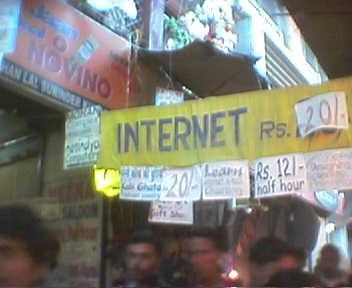
Thanks to advertising through a local Internet café, a woman wanted for suspected theft for two years fell into the hands of local authorities.
According to a report published in the Netopia website, Madelyn Pon Nieva was captured after her picture was first published through the Internet café’s advertisements, which appears as a screen saver in all of establishments’ computer terminals.
For complete story Read : INQ7.net
Tuesday, May 18, 2004


Thursday, January 29, 2004
Brazil bets on Linux cybercafes : BBC News
Unemployed and living in one of the poorest areas of Sao Paulo City, which has a high rate of violence and little to do, 19-year-old Jose Antonio de Oliveira Silva used to spend most of his time at home.
But that all changed with the opening in Cidade Tiradentes of a "telecenter", a free internet cafe set up by the local authority.
"Now I come here almost every day," said Jose Antonio, who is taking courses in computer and writing skills.
He spends one hour a day, the maximum time allowed per person, practising on the computer and hopes that the new skills will help him in the search for a job.
"I know people who have got jobs because they knew how to work with computers," he said.
Finding a job is also Elaine Guimaraes' prime concern. Unemployed for five years, she uses the net to register with job websites, e-mail her CV and to access services such as government benefits.
She learned how to use a computer at the Telecenter Cidade Tiradentes.
"During my last job, computers were something new. But now, if I find a job I will have to know how to use them," she said.
Lack of jobs
Getting a job is the number one worry here. Sao Paulo City has an unemployment rate over 20%, but in Cidade Tiradentes, with its 130,000 inhabitants living in social housing projects, the rate is even higher.
Walking around on a weekday, you can see just how many people are on the streets doing nothing.
"Ninety-eight percent of people living here didn't have access to computers before," said Jesulino Alves de Souza, who co-ordinates the centre.
Now, some of them, after learning at the centre, have saved money to buy their own computer to use at home.
A resident of the area for 11 years, Mr Souza believes the Telecenter has become an important part of the lives of many young people in the area.
It has never been robbed or vandalised, unlike other inner city public buildings and schools.
"Maybe because they know that we are here to serve the community," he explained.
'Fundamental right'
The Telecenter project was started two and a half years ago in Sao Paulo by a left-wing local government as part of a digital inclusion plan that aimed to improve access to information.
Research carried out that year showed that there were about three million people in Sao Paulo without any access to computers. Now, about 250,000 people are using the nearly 100 net cafes.
| The government is the biggest software buyer. We can save a lot of public money using the free software solution Beatriz Tibirica, E-Government project |
Although ownership of a computer and access to the internet are common for middle-class Brazilians, of the population as a whole fewer than 10% have access to the net.
"We want to take the telecenters to the poorer areas in the periphery, to reduce the social and economic divide," said Beatriz Tibirica, co-ordinator of a project called E-Government.
"Access to technology is fundamental in order to get full rights and opportunities in modern society", she added.
Each telecenter has about 20 computers. Some are used for the courses and others are free to be used for anything from preparing homework for checking the latest about soap stars.
Since last year, all the centres have been using the free operating system GNU/Linux.
"The government is the biggest software buyer," said Ms Tibirica. "We can save a lot of public money using the free software solution."
She pointed out that the free software has many advantages: no need to pay for licences and it is possible to use a simpler version of the computer, with one server and several thin clients - computers without hard disks.
These computers, according to Ms Tibirica, cost a quarter of the price of a machine and have reduced maintenance costs.
Education experiment
Moving from paid to free software to reduce costs is part of a national government plan.
The idea is going to be tested on a larger scale in the next few months, when the Ministry for Education buys new equipment.
A new bid is under way to buy 10,000 computers for schools. There are already 230,000 computers in 43,000 schools around the country, most of them using proprietary software like Microsoft Windows.
The new computers will be able to work with both proprietary and open source software.
"More than saving money, which is important enough, the free system will allow us to create a network of knowledge in the field," said Americo Bernardes, director of the National Program for Informatics in Education (Pro-Info).
But he admitted that this was an experiment. "The government is using the free system in some administrative offices. But using it in schools, with students, has a much bigger impact," said Mr Bernardes.
Friday, July 27, 2001
Africa's booming cybercafes buzz in no-frills milieu
Africa's booming cybercafes buzz in no-frills milieu
Entrepreneurs scramble to open more
Hiawatha Bray, Boston Globe
Sunday, July 29, 2001
Nairobi -- There's no air conditioning at Browse Internet Access, on the fourth floor of a downtown office building here, just fans and windows thrown open to the temperate air of this mile-high Kenyan city.
But that isn't enough to disperse the warmth generated by five dozen computers, the five dozen people who use them, and a half-dozen others quietly waiting their turn.
They call this stuffy, crowded place a cybercafe, although there's not an espresso machine in sight. And those who come to Browse don't do a lot of browsing. They're here to communicate with family and friends they could never afford to reach by telephone. Or they come here to work.
Whatever their reason, Nairobians just keep coming. When Stephen Onyambu and his wife, Pamella, started Browse in 1998, it had just 12 computers. Today,
there are 60, yet people still wait in line. "By the end of the year, God willing . . . we should have 120," said Stephen Onyambu.
Browse has plenty of competition. A visitor will find a cybercafe on practically every block in the city center. And not just in Nairobi. The fashionable districts of Cape Town are littered with Internet cafes. Accra, in Ghana, has nearly a hundred. Nairobi-based Africa Online boasts more than 250 cafes scattered around the continent. And entrepreneurs from Africa and Europe are scrambling to open still more.
In America, the cybercafe boom died out by the late 1990s, the victim of cheap home computers and all-you-can-eat Internet access. But the cybercafe concept makes more sense in Africa, where only a fraction of the population has telephones, much less computers. For decades, people here have walked to the neighborhood call center to telephone a friend or relative abroad. Now the same concept is being applied to the Internet, and in Africa's biggest cities, thousands are lining up to get online.
They come to places like Browse for a variety of reasons. If Josephine Ndunga, 22, a computer science student at a local college, had been a student in the United States, she would have stayed on campus to send e-mail to her fiance in Seattle. After all, nearly every American college provides a free link to the Internet.
But due to the high cost of Internet access in Kenya, her school charges students to hook up to the Web, and Browse is cheaper. "I was introduced to it by a friend and I liked it," she said. "There are lots of computers, so you don't have to wait."
A few feet away, Kevin Machine buffs up his resume. Machine, 25, is a German teacher who wants to see the world. "I'm looking for a job," he joked. "Kosovo. Uganda. Anywhere."
Steve Thoithi, 32, already has a job; in fact, he's doing it at Browse. Thoithi, an economist turned Internet entrepreneur, designs Web sites for companies in Kenya, Uganda, Tanzania -- whoever will hire him. Thoithi prefers logging on at a cybercafe when it's time to go online. "I do have an account at home," he said. "But it costs more." Here at Browse, he pays 7 Kenyan shillings for 3 minutes -- the equivalent of 9 U.S. cents.
Still, Thoithi isn't satisfied. He's found a competing cafe that he likes better. "They charge a shilling a minute, and the speed is not that bad."
It's no surprise that download times at Browse are nothing to boast about. Given the high cost of bandwidth in Africa, no cybercafes have the kind of high-speed connections that are found in almost all American businesses. Indeed, African cybercafes can't even match the speeds available to the typical home user in the United States.
For instance, an American's telephone modem can download Internet data at around 56,000 bits per second. At Browse, 60 computers share a single digital line with a top speed of 144,000 bits per second. This one connection is far slower than the cable modems, or DSL lines, found in millions of U.S. homes. And divided by 60 users, it works out to just 2,400 bits per second -- agonizingly slow for downloading Web pages.
Like so many other African businesses, the cybercafes are shackled by the huge cost of bandwidth on the continent. Because there's no direct cable connection between Kenya and the rest of the world, all of the country's Internet traffic relies on satellite connections, which are far more expensive than the fiber-optic links that connect the United States to Europe and Asia.
Browse's Internet connection costs the company about $5,000 a month. By comparison, an American business can buy a T-1 Internet line, which is 10 times as fast as the Browse connection, for under $1,000 a month.
Internet connections are cheaper in South Africa, by far the most technologically advanced nation on the continent. But that's had the ironic result of making cybercafes less popular there than in other African countries.
Of South Africa's 43 million people, it's estimated that 1.5 percent, or about 650,000, have Internet access at home. That is more Internet users than the rest of Africa combined. And this group comprises South Africa's political,
intellectual and business elite.
In other African countries, such people can be found in the cybercafes. In South Africa, they're in the office or at home.
So it's no surprise that South Africa's cybercafes seem curiously devoid of Africans. "Ninety-eight percent of the visitors are international travelers," said Ursula Brown, founder of the Cyber Java cafe in Cape Town's Sea Point district.
But elsewhere on the continent, cyber-entrepreneurs see good opportunities. Mark Davies is a Welshman who went to New York and started an Internet business, which he sold to Ticketmaster-CitySearch in 1998. His new firm, BusyInternet, is building a huge public Internet facility, in the heart of one of Africa's most competitive Internet environments: Accra, Ghana.
Davies fell in love with Ghana when he visited the country as a teenager. He originally planned a philanthropic venture to provide better communications to people in Africa. But as he considered the failures of other misbegotten African aid programs, Davies had a change of heart.
"We decided that it was a healthier approach that the business should stand on its own two feet," he said. "It's very important that it has the rigor of a for-profit business." Davies' determination to make money on the deal has impressed Ghanaian investors, who have contributed half of the project's $1.5 million cost
Entrepreneurs scramble to open more
Hiawatha Bray, Boston Globe
Sunday, July 29, 2001
Nairobi -- There's no air conditioning at Browse Internet Access, on the fourth floor of a downtown office building here, just fans and windows thrown open to the temperate air of this mile-high Kenyan city.
But that isn't enough to disperse the warmth generated by five dozen computers, the five dozen people who use them, and a half-dozen others quietly waiting their turn.
They call this stuffy, crowded place a cybercafe, although there's not an espresso machine in sight. And those who come to Browse don't do a lot of browsing. They're here to communicate with family and friends they could never afford to reach by telephone. Or they come here to work.
Whatever their reason, Nairobians just keep coming. When Stephen Onyambu and his wife, Pamella, started Browse in 1998, it had just 12 computers. Today,
there are 60, yet people still wait in line. "By the end of the year, God willing . . . we should have 120," said Stephen Onyambu.
Browse has plenty of competition. A visitor will find a cybercafe on practically every block in the city center. And not just in Nairobi. The fashionable districts of Cape Town are littered with Internet cafes. Accra, in Ghana, has nearly a hundred. Nairobi-based Africa Online boasts more than 250 cafes scattered around the continent. And entrepreneurs from Africa and Europe are scrambling to open still more.
In America, the cybercafe boom died out by the late 1990s, the victim of cheap home computers and all-you-can-eat Internet access. But the cybercafe concept makes more sense in Africa, where only a fraction of the population has telephones, much less computers. For decades, people here have walked to the neighborhood call center to telephone a friend or relative abroad. Now the same concept is being applied to the Internet, and in Africa's biggest cities, thousands are lining up to get online.
They come to places like Browse for a variety of reasons. If Josephine Ndunga, 22, a computer science student at a local college, had been a student in the United States, she would have stayed on campus to send e-mail to her fiance in Seattle. After all, nearly every American college provides a free link to the Internet.
But due to the high cost of Internet access in Kenya, her school charges students to hook up to the Web, and Browse is cheaper. "I was introduced to it by a friend and I liked it," she said. "There are lots of computers, so you don't have to wait."
A few feet away, Kevin Machine buffs up his resume. Machine, 25, is a German teacher who wants to see the world. "I'm looking for a job," he joked. "Kosovo. Uganda. Anywhere."
Steve Thoithi, 32, already has a job; in fact, he's doing it at Browse. Thoithi, an economist turned Internet entrepreneur, designs Web sites for companies in Kenya, Uganda, Tanzania -- whoever will hire him. Thoithi prefers logging on at a cybercafe when it's time to go online. "I do have an account at home," he said. "But it costs more." Here at Browse, he pays 7 Kenyan shillings for 3 minutes -- the equivalent of 9 U.S. cents.
Still, Thoithi isn't satisfied. He's found a competing cafe that he likes better. "They charge a shilling a minute, and the speed is not that bad."
It's no surprise that download times at Browse are nothing to boast about. Given the high cost of bandwidth in Africa, no cybercafes have the kind of high-speed connections that are found in almost all American businesses. Indeed, African cybercafes can't even match the speeds available to the typical home user in the United States.
For instance, an American's telephone modem can download Internet data at around 56,000 bits per second. At Browse, 60 computers share a single digital line with a top speed of 144,000 bits per second. This one connection is far slower than the cable modems, or DSL lines, found in millions of U.S. homes. And divided by 60 users, it works out to just 2,400 bits per second -- agonizingly slow for downloading Web pages.
Like so many other African businesses, the cybercafes are shackled by the huge cost of bandwidth on the continent. Because there's no direct cable connection between Kenya and the rest of the world, all of the country's Internet traffic relies on satellite connections, which are far more expensive than the fiber-optic links that connect the United States to Europe and Asia.
Browse's Internet connection costs the company about $5,000 a month. By comparison, an American business can buy a T-1 Internet line, which is 10 times as fast as the Browse connection, for under $1,000 a month.
Internet connections are cheaper in South Africa, by far the most technologically advanced nation on the continent. But that's had the ironic result of making cybercafes less popular there than in other African countries.
Of South Africa's 43 million people, it's estimated that 1.5 percent, or about 650,000, have Internet access at home. That is more Internet users than the rest of Africa combined. And this group comprises South Africa's political,
intellectual and business elite.
In other African countries, such people can be found in the cybercafes. In South Africa, they're in the office or at home.
So it's no surprise that South Africa's cybercafes seem curiously devoid of Africans. "Ninety-eight percent of the visitors are international travelers," said Ursula Brown, founder of the Cyber Java cafe in Cape Town's Sea Point district.
But elsewhere on the continent, cyber-entrepreneurs see good opportunities. Mark Davies is a Welshman who went to New York and started an Internet business, which he sold to Ticketmaster-CitySearch in 1998. His new firm, BusyInternet, is building a huge public Internet facility, in the heart of one of Africa's most competitive Internet environments: Accra, Ghana.
Davies fell in love with Ghana when he visited the country as a teenager. He originally planned a philanthropic venture to provide better communications to people in Africa. But as he considered the failures of other misbegotten African aid programs, Davies had a change of heart.
"We decided that it was a healthier approach that the business should stand on its own two feet," he said. "It's very important that it has the rigor of a for-profit business." Davies' determination to make money on the deal has impressed Ghanaian investors, who have contributed half of the project's $1.5 million cost
Subscribe to:
Posts (Atom)